


Hey there! As a supplier of HK Sealing Brush, I often get asked about all sorts of technical details. One question that pops up quite a bit is about the Poisson's ratio of HK Sealing Brush. So, let's dig into it and break it down in a way that's easy to understand.
First off, what the heck is Poisson's ratio? Well, it's a measure of how a material behaves when it's stretched or compressed. When you pull on a material in one direction, it usually gets thinner in the perpendicular directions. Poisson's ratio tells you how much it thins out compared to how much it stretches. It's a ratio of the transverse strain (the change in thickness) to the axial strain (the change in length).
Now, let's talk about HK Sealing Brush. These brushes are used in a bunch of different applications, especially in tunnel boring machines (TBMs). They're super important for sealing and preventing the leakage of water, soil, and other stuff. You can check out more about Hk Tailskin Sealing Brush, Tailskin Seal Brush, and TBM Rear Brush on our website.
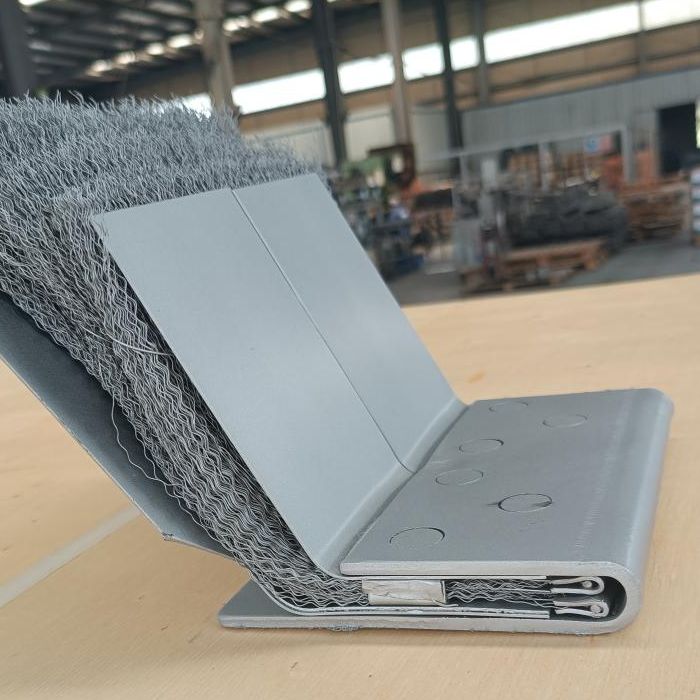
The Poisson's ratio of HK Sealing Brush depends on a few factors. The materials used to make the brush play a huge role. Most of these brushes are made with high - quality bristles and a strong backing material. The bristles are usually made of synthetic fibers or metal wires, and the backing can be rubber, plastic, or a composite material.
Synthetic fiber bristles, for example, tend to have a relatively high Poisson's ratio. When you stretch a synthetic fiber in one direction, it will contract significantly in the other directions. This is because the molecular structure of the synthetic fibers allows for some flexibility and rearrangement of the molecules when a force is applied.
On the other hand, metal wire bristles have a lower Poisson's ratio. Metals are more rigid at the atomic level, and their atoms are held together by strong metallic bonds. So, when you stretch a metal wire, it doesn't change its thickness as much as a synthetic fiber would.
The backing material also affects the overall Poisson's ratio of the HK Sealing Brush. If the backing is a soft rubber, it will have a higher Poisson's ratio compared to a hard plastic backing. Rubber is more elastic and can deform easily under stress, causing it to change its shape more in the transverse directions when stretched or compressed.
Let's think about how this Poisson's ratio stuff matters in real - world applications. In a TBM, the HK Sealing Brush needs to be able to adapt to different pressures and movements. When the TBM is moving forward, the brush may be compressed against the tunnel wall. The Poisson's ratio determines how the brush will expand in the directions perpendicular to the compression.
If the Poisson's ratio is too low, the brush may not expand enough to create a good seal. This could lead to leakage of water or soil, which can be a big problem for the tunneling operation. On the other hand, if the Poisson's ratio is too high, the brush may expand too much and cause excessive wear and tear, reducing its lifespan.
We've done a lot of testing in our lab to find the optimal Poisson's ratio for our HK Sealing Brushes. We use advanced testing equipment to measure the strain in different directions when a force is applied to the brush. By adjusting the materials and the manufacturing process, we can fine - tune the Poisson's ratio to meet the specific requirements of our customers.
For example, if a customer needs a brush for a high - pressure tunneling environment, we might choose materials with a slightly lower Poisson's ratio to ensure that the brush can withstand the pressure without excessive expansion. For a low - pressure application, we can use materials with a higher Poisson's ratio to create a better seal.
Another aspect to consider is the durability of the HK Sealing Brush. The Poisson's ratio can also affect how the brush holds up over time. A brush with an appropriate Poisson's ratio will be less likely to break or lose its shape during repeated use. This means that it will last longer and provide a more reliable seal.
In addition to the materials and the Poisson's ratio, the design of the HK Sealing Brush also plays a role in its performance. The density of the bristles, the length of the bristles, and the arrangement of the bristles all interact with the Poisson's ratio to determine how well the brush will work.
We're constantly researching and developing new ways to improve our HK Sealing Brushes. We're looking into new materials with better properties and new manufacturing techniques to make the brushes more efficient and durable.

If you're in the market for HK Sealing Brushes, whether it's for a small - scale project or a large - scale tunneling operation, we'd love to hear from you. Our team of experts can help you choose the right brush based on your specific needs, taking into account factors like the Poisson's ratio, the operating environment, and the expected lifespan of the brush.
We understand that every project is unique, and we're committed to providing high - quality products that meet your exact requirements. So, don't hesitate to reach out to us for a consultation. We can discuss your project in detail and come up with the best solution for you.
In conclusion, the Poisson's ratio of HK Sealing Brush is an important factor that affects its performance, durability, and sealing ability. By carefully selecting the materials and optimizing the design, we can create brushes that are tailored to different applications. If you have any questions or if you're interested in purchasing our HK Sealing Brushes, just let us know. We're here to help you make the right choice for your project.
References
- Textbooks on material science and engineering for general knowledge on Poisson's ratio.
- In - house research and testing data on HK Sealing Brushes.


